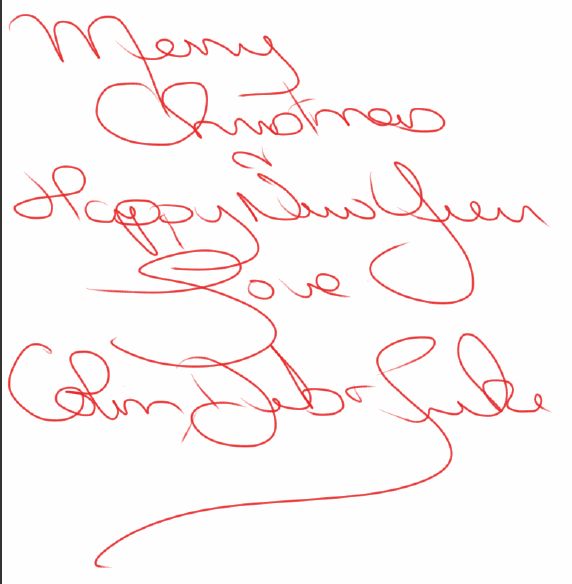
The sending and receiving of Christmas cards—or greeting cards
period, for that matter—is a tradition going way back in time.
The first commercial Christmas cards were commissioned by Sir
Henry Cole, in London in 1843.

They became so popular that it was unthinkable
in certain society not to send cards. After a period and certainly when I was a
child, sending Christmas cards was something you simply did, no questions
asked. I used to love the card garlands my parents would make and I loved to
flip up their festive covers to expose the signature underneath.
Over the years I have adored both sending and getting Christmas
cards from loved ones near and far. When the season is over, I cut the cards up
and use them the next year as tags for the gifts. We also use the same gift
bags in our family year after year. This year I am buying yards of soft
tulle-like fabric that can be used as the stuffing of the bags instead of
tissue and reused every year. These things are my tiny efforts to mix the
traditions with the realities of this world. Small, but something. And yet the
pressure to end this tradition mounts every year.
Fewer and fewer of our friends send Christmas cards and I
understand the reasons—footprint, time, expense. Still I miss these cards. It’s
not even the cards I miss so much, but the signatures. What I really love about getting cards is
seeing our friends’ handwriting. It is so comforting to open up a card and just
by the valediction know exactly who sent it.
And when I was doing our cards last night, I was thinking about
the relationship between John Hancock and our son’s generation. It dawned on me
that this generation has no connection to handwriting. They could not begin to
recognize a friend’s cursive scroll and feel warmed by it. They won’t look at a
note and recognize it as Bill or Megan’s handwriting. Because they don’t. Write,
that is. With pen or pencil. They simply don’t write. And they don’t care. Why
would they? They don’t want for what they never had.
Me? I will miss seeing our loved ones dotted i’s and crossed t’s
on our Christmas cards. I will miss seeing the flourish that Kathy gives to her
“L’s” and the looped curve to the “C” that identifies Christopher’s note. I
love my friends’ handwriting. It is so personal. It’s who they are; it’s part
of them.
So at some point, probably next year, we will give up the sending
of cards and do them online. We will send by mail to the aunts and uncles and
friends who are not online and that will cut down the cards by ninety percent.
But it’s not the same. At least for me. You can send me the most beautiful e-card
in the world and I may even play it over and over. But it won’t have your
personality scrolled across the bottom. It will simply say, “Love, Doug, Janet,
Tyler and Grace”. I’ll be glad you sent it. But I will miss the you in it.
What are you going to do? The handwriting is on the Facebook Wall.
Barbara: I never thought about looking at people’s handwriting
and seeing it as an intimate extension of who they are. Of course it is! And I
must have noticed it, but I’ve never thought
of it. And now that you mention it, it is a special communion. It is distinctly
personal, revealing, sacred.
All this said, I often think of my own writing as the side of me
I’d rather hide, like ugly toes or excessive sweat. My handwriting is
atrocious. It is hurried and sloppy and barely legible—even to me. And what’s
more, it is often physically painful for me. When I was young, I used to
develop these hard little balls under the skin near my wrist from the
“exertion” of writing. The top knuckle of my middle finger veers right thanks
to the pressure I put on it as a rabid teenaged writer. Computers have saved me
from confusion (others’ and my own), have saved me time, have cleaned me up for
the world, like a mom slicking back her kid’s unruly hair while wiping the grime
from their cheek. I was getting seduced into thinking this was a better me I
was showing to the world. And yet, to your point, Deb, it’s not the real,
unadulterated me.
My other weakness is in the whole sending of mail. I am terrible
here too. I have long ago accepted I would rarely, if ever, send anything by
mail. Legions of letters, packages, and warrantees have languished on my hall
table to slowly gather dust and eventually be tossed.
I admire you and your ilk. I have treasured every card you have ever
sent me and admired every stroke of your thoughtful pen. I love getting real
mail. I love getting real cards. I will miss the ritual when it passes.