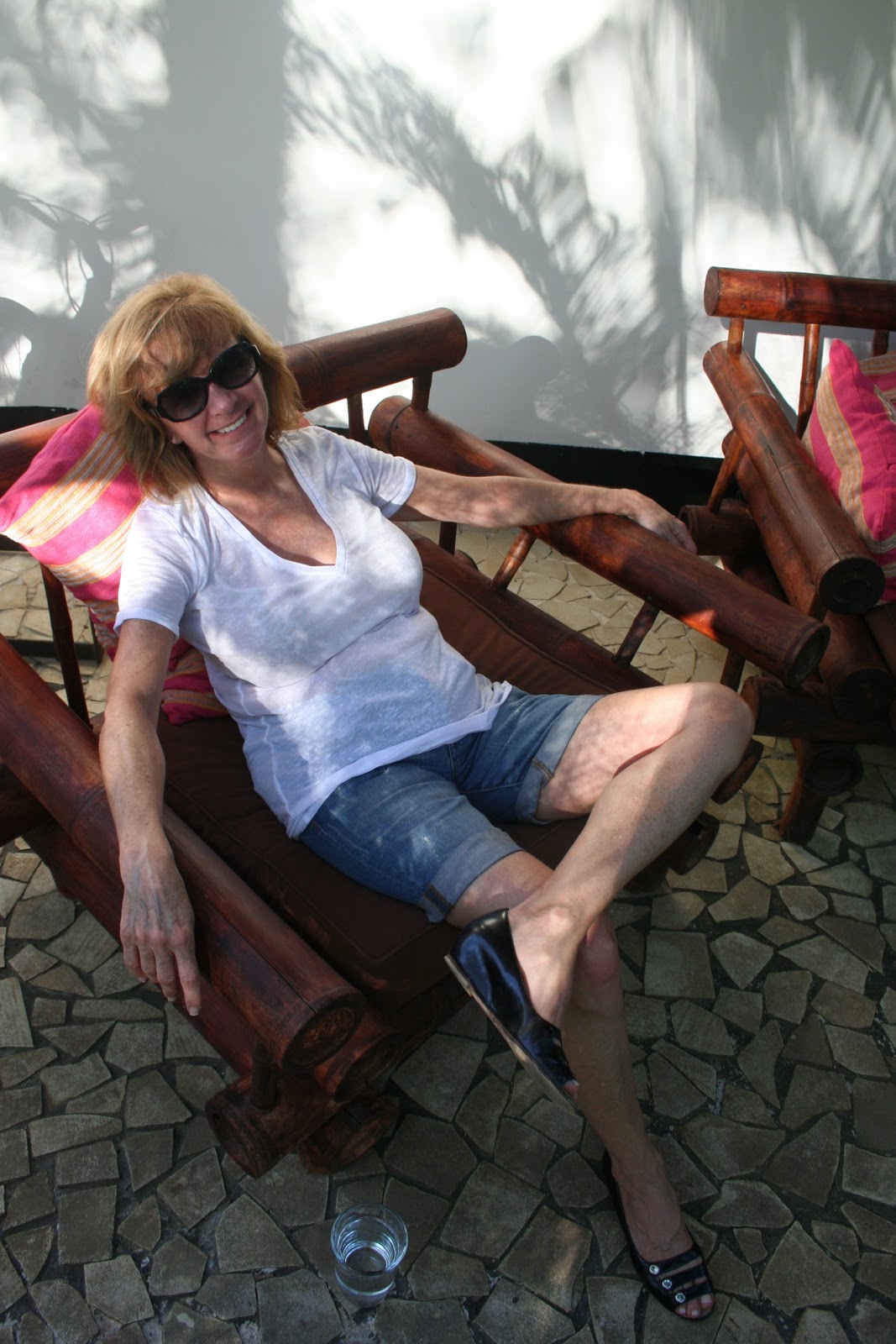
Deb and Barbara: “Pura Vida”
literally translated means "pure life", but it swings many ways too.
For example, "How are you?"..."Pura Vida!" It falls into
the category of all things lovely in feeling and tone and greetings. It holds
its own with the Jamaican "Irie", the Australian "No
worries", or even the Italian "Dolce far niente", which of
course means, "How sweet to do nothing”. So this is a tribute to Pura Vida,
which was our experience and our heart in Costa Rica. We would like to share
with you some wonderful random and not so random tidbits from our trip. Some
fact, some funny, some silly. And, of course, more photos!
Tico and Tica
Barbara:
This is how the Costa Ricans refer to themselves and each other (tico for
males, tica for females). What I love about these words—which are used by
everyone here, even officially (as we noted yesterday, the English newspaper is
called The Tico Times)—is that this got its start because of the common use of
the suffix-endearment “tico” (or “tica”) on every word. So, on the one hand,
it’s kinda like “gentleman” or “woman”, but on the other, it’s a bit like saying
“sweetie” all the time. This is a practice after my own heart, sweeties!
Packing for your trip to Costa Rica
Deb: As you all know I
love clothes and I love a good pack. I think I bragged ad nauseam about my
stellar Newfoundland packing. This time I was a tad off the mark. So you won't
be when you go to Costa Rica, I will share the following tips.
1. Rainforest, as
shocking as it may seem, means rain. So make sure you are prepped with layers
and rainproof clothing. We were. But ... we did not know that we would need it
for the entire time in the rain/cloud forest. Now, this is not always the case,
but ... be prepared. Check the weather! And take good waterproof walking shoes.
We lucked out on our tour day, but we only had a drizzle. Others weren’t so
lucky. Yet it is still delightful if you are prepped and dry.
2. We OVERDRESSED. By
that I mean too dressy. These were elegant dining rooms and top-of-the-line
service and quality, but they were also ... Pura Vida ... whatevs! We could
easily have shown up in khakis and a clean t-shirt and fit right in. So ... no
pressure to pack dresses and fancy what-have-yous. Our last hotel, The Harmony Hotel,
offered a wash, press, and delivery service for $1.50 a piece. WOW. Bargoon, I
am thinking.
Barbara:
These are the clothes I would most recommend for a multi-ecosystem Costa Rican
stay: 2 light-weight sweaters (for layering), 1 hoodie-type sweatshirt, 1 light
hooded raincoat, several t-shirts, several tank tops, 2 long pants, 1 pair
casual shorts and 1 pair capris, 1 casual skirt, 1 sundress, 1 lightweight
scarf, 1 or 2 sunhats, 1 pair comfy walking shoes that can be hosed off, 1 pair
water sandals, 1 pair nice sandals, 1 travel shirt (for return trip), bathing
suit(s) and cover-up. Of course, don’t forget the sunscreen and bug spray! Many
hotels in the rainforests will lend you wellies for your hiking, but these are
only necessary if the rain is really heavy or the trail really muddy (the rain
we had when we were at El Silencio was more of a mist and their trails very
well maintained; we were fine with our rubber-soled Mary-Janes and running
shoes).
 |
| Barbara insisted on this photo -- so impressed was she with the lack of mud on our shoes after the rainy hike! Never be afraid of a rainy hike. Magical. |
Is Costa Rica safe?
Barbara:
Don’t let people scare you into thinking Costa Rica is unsafe or scary. We saw
no signs of crime nor did we hear any untoward stories. The people here are so
very decent and proud. They are helpful to and respectful of each other. One
example: we were stopped on a roadway because of construction and our driver
rolled down his window and extended his bottle of water to the worker manning
the stop-and-go. The worker—who was baking in the hot sun—gratefully accepted.
It’s a small gesture, maybe, but typical in its gentle kindness. Of course
there must be crime here—these are still people after all, with all our foibles
and failings. But we never ever worried about our safety … because there was
nothing to worry about. Consider also that Costa Rica is the leader on the Happiness Index and maybe you can understand that crime is less an issue here than
elsewhere.
As for food and water: the
water has been safe for a long time, but all of our resorts purified their
water in ecological ways. We already described the water at El Silencio as
being filtered for sediment and then purified with ultra-violet light. This is
sound practice for destroying harmful microorganisms. We drank the tap water,
baby, and never got sick (or felt even “off”). And I have a notoriously
sensitive stomach.
Shopping in Costa Rica
Deb: Regards shopping. And this applies
to our experience ONLY. We shopped at the Maleku tribe (without pressure) for
tiny lovely handmade items! I bought one for me and one for the boy and his
girl because I wanted them to have bracelets that were eco-friendly and
authentic to the Maleku tribe, and to help the tribe out financially.
When
we got to The Harmony Hotel, there were lovely, wonderful, chic, local handmade
items in every shop in the minutes-away village. Our favourite shop was just
outside the gates of our lovely Harmony Hotel. It is called BAZZAAR and it was
so chic and bursting that we managed to pick up a few wonderful items that I
already treasure. Barb and I fell in love with similar rings (different shapes
and slightly different colours), but reflecting our own sizes and tastes. We
love these rings because they symbolize our friendship and bond on this trip
and will serve as a wonderful memory for us.
The areas we visited
Barbara:
We realized too late that we didn’t really describe for you the specific areas
where our hotels were located. El Silencio Lodge and Spa was located about 1 ½
hours north(ish) of Juan Santamaria International Airport (a very modern
airport, btw) in the Central Volcanic Valley and is flanked by 2 national parks
(and its own extensive reserve). The closest town is Sarchi.
Arenal Springs Resort and
Spa (at posting time, I could not link to this hotel, stay tuned) is on the opposite side of the volcano from La Fortuna (the nearest town),
but this is a mere 15-minute drive. There are many hotels in this ‘hood, but
they are all discreetly hidden amid the forest.
And The Harmony Hotel is in
the Nosara area—an area known for its amazing surfing and charming little towns
and shops. Nosara is on the Pacific coast in the Guanacaste area (the warm,
dry, golden coast) at about the halfway mark. Again, everything here is still
pretty discreet, with no high-rises or massive condos. On the beach itself, you
see virtually no sign of development. Hopefully, it stays this way! My husband
is an avid diver, but it looks like you need the reef-filled waters of the
Papagayo area (about 2-3 hours north of Nosara) for that. It might be partly due
to the surfer ‘tude of the coastal towns or could be thanks to the Costa Rican
traditional cooking around rice and beans, but Costa Rica is a perfect
destination for vegetarians and vegans—tons of culinary choice for you!
Costa Rican Spanish
Deb: One of our favourite parts of the
trip—which also became our running gag—stemmed from a book Barb gave me on
Spanish language travel. When I got to the part about love and sex my day was
made and the theme for our trip was established. The following is an excerpt
from the book:
YOU
CANNOT MAKE THIS STUFF UP! “DON'T WORRY, I'LL DO IT MYSELF”!!!!
We
squealed and delighted and the theme of the trip became, "Easy, tiger!" We now wish we had executed it Spanish-style, a la "Suave, tigre” (swa-ve tee-gre), which we will henceforth adopt. We were searching for a replacement
for, "That's what she said" and we think we have found it!!!!
Bugs
Barbara: Funny thing … yeah,
there are mosquitoes and other bugs, but we had so little problem with them. We
hiked the rainforest, wandered the herb garden, horseback rode through forest
and along beach, and have little pain to show for it. We used bug spray at the
Maleku reserve because José cautioned us it would be mosquito-filled. So we
did. But we forgot to spray on our horseback ride. We did feel bites, but the
mosquitoes here seem to take only tiny morsels and leave the teeniest spots,
which do itch for about an hour and then … nothing. Weird. I would still
recommend spray as a precaution, but we were shocked at how rarely we used it
or needed to use it.
Driving times in Costa Rica
Deb: Another tip we
can offer to those making plans to head to Costa Rica is about the drive times.
Do not be fooled by the kilometer mileage. Keep in mind the 60mph restrictions,
slow trucks, and winding roads. Give yourselves true time, sit back and enjoy
the scenery and the ride. Our trips were made much easier by Barb's nut and
chocolate-rosebud bag of goodness! Thank you, Barb. Of course, I sat on a
rosebud and had chocolate bud-prints on arrival at Juan Santamaria airport.
Barb joined me in the loo and scrubbed it off––"Suave, tigre!"––See
how that works? Now you can play!
Recognizing Colin
Barbara: A
few of you wondered if Colin was approached by many tourists on our trip. We
told you some stories, but kinda forgot the funniest part—he was often (very
often) recognized by local Costa Ricans! I had no idea they got Whose Line
here. I will also add that—apart from a gaggle of giggling local teens who
passed us during our horseback riding tour—the tico/tica fans were so discreet
that we had NO idea they knew him … until after our tour or meeting when they
offered him a gentle thank-you for the wonderful gift of laughter he gave them
over the years. Colin, of course, was his usual gracious self during these
encounters.
Thank you!
Deb: We were each given a "Gift of
Happiness" water bottle when we arrived at El Silencio as part of our
package, but we had no idea until we read the "fine print"—in this
case, a good thing—what a gift it really is.
And
to The Harmony Hotel where we ate such gorgeous meals (choosing to eat at the
hotel every night because the food and service kept calling us back), and where
we had wonderful bamboo massages, and front desk service with such elegant
laidback style—thank you. You offered free Sustainability Tours of the hotel
and the garden. Who does that? People who have nothing to hide, I guess. People
who are proud of their job and their life and are eager to share it with the
world.
That
is what we saw and what we experienced. I should say at this point that NO ONE
from the Costa Rica Tourism Board on down asked us for anything in return or
had any mandate whatsoever. They did not ask us to blog or to censor ourselves
in any way if we did choose to blog.
They
gave us a gift. We accepted and now we are giving one back. I guess the biggest
compliment we can give to our hosts is ... we will be back. And we will send
likeminded souls to you. You will continue to do what you do ... Pura Vida.
Barbara: A huuuuuge thank you to all our hosts, to the hotels and staff, to the
Costa Rica Gift of Happiness, and to all those involved in making our trip such
a stunning success.
 |
| Plantains (which are fried and featured in every tipico meal). |
 |
| Hiking tour of El Silencio -- and staring in wonder at a Jurassic era fern. |
 |
| Yup, we totally represented those ubiquitous tech geeks who spend their holiday on their computers. We did it for you! |
 |
| José of the Maleku tribe pointing out the iguana skin on the tribal drum. |
 |
| Rigoberto, tribal chief, showing us how they wrap the fish in leaves for cooking (and which we later ate). |
 |
| Deb best capturing just how bitter this herb was that Rigoberto had us sample. |
 |
| Pretty shoes in the mud! |
 |
| Meilyn showing us the red stain on her hands. |
 |
| All of us on our wonderful day. |
 |
| Interesting signage at Arenal Springs Resort and Spa. |
 |
| And fun signage. The first regulation had us tittering for a while... |
 |
| ...And prompted flagrant rule-breakers Barbara and Phil from playing out a little under-water "love scene". |
 |
| Yup, happy. |
 |
| Yup, her too. |
 |
| Beautiful flowers. |
 |
| Fun at dinner at El Silencio. |
 |
| Fun at lunch with the Maleku. |
 |
| All of us driving from Arenal to the Harmony. Our most excellent driver, José, gamely put up with our antics. |
 |
| Anniversary night! |
 |
| The pristine beach near The Harmony Hotel in one direction... |
 |
| ...And the other. |
 |
| Deb, Barbara, and Phil just really liked this shot. |
 |
| Happy setter clearing the beach of birds. |
 |
| We could never decide which of the two adorable shots we had of little Lucerno to post. Pic #2. |
 |
| And lunch (soft chicken tacos and grilled fish wrap. Those gorgeous beverages? Healthful -- and virgin -- elixirs at the Harmony. Soooo yummy. |
 |
| This is fried red snapper, sautéed kale and carrots, and boiled yucca with roasted garlic at the Harmony. It was divine. |
 |
| Barbara's gentle friend, Marta. |
 |
| Getting into the mood right before our bamboo massages at the Harmony. |
 |
| Wet but happy. (... Suave, tigre.) |